Why Lens Material Matters
Choosing the right eyeglasses starts with one question: what types of glasses lens material will work best for you? The answer shapes weight, thickness, impact safety, optical clarity, and even how comfortably your lenses sit in the frame. As a manaufacturer that has produced resin lenses since the 1990s, we have seen how a small material decision can make a big difference in everyday vision. This guide explains the common lens materials, their advantages and limitations, and what to consider when deciding.
Types of Glasses Lens Material
Most prescription lenses today are made from organic resin. Within that broad family, there are several distinct categories, each with its own balance of clarity, durability, weight, and cost. Glass remains the oldest option, while modern high-index plastics have largely replaced it for high prescriptions.
Glass lenses
Glass was the original lens material. It offers outstanding optical clarity and scratch resistance, but it is heavy and can shatter on impact. Today, glass is rarely used for everyday eyewear, especially when lighter resin alternatives are available.
Standard plastic lenses
Standard plastic, also known as CR-39 resin or ordinary optical resin, is one of the most common types of glasses lens material. It has a refractive index of about 1.50 and an Abbe value close to 58, meaning excellent optical clarity. Plastic lenses are lightweight, affordable, and easy to tint. They are best suited to low and moderate prescriptions.
Polycarbonate lenses
Polycarbonate is a high-impact, lightweight material with a refractive index of 1.59. It is a popular choice for children, active adults, and safety eyewear because it resists impact and offers built-in UV protection. The trade-off is a lower Abbe value around 30, which can produce more chromatic aberration in some wearers.
Trivex lenses
Trivex is another impact-resistant material, with an index of about 1.53 and an Abbe value near 45. It combines polycarbonate's toughness with better optical quality and a slightly lower weight. For patients who need durable lenses but notice colour fringing with polycarbonate, Trivex is an excellent alternative.
High-index plastic lenses
High-index lenses are formulated for stronger prescriptions. The term "index" refers to how efficiently a material bends light; a higher index means the lens can be thinner and flatter for a given power. Common options include 1.60 (often made from MR8 material), 1.67, and 1.74. These materials are ideal for moderate to high myopia, astigmatism, or presbyopia. A lens with an anti-reflection coating is recommended because high-index materials reflect more light without it.
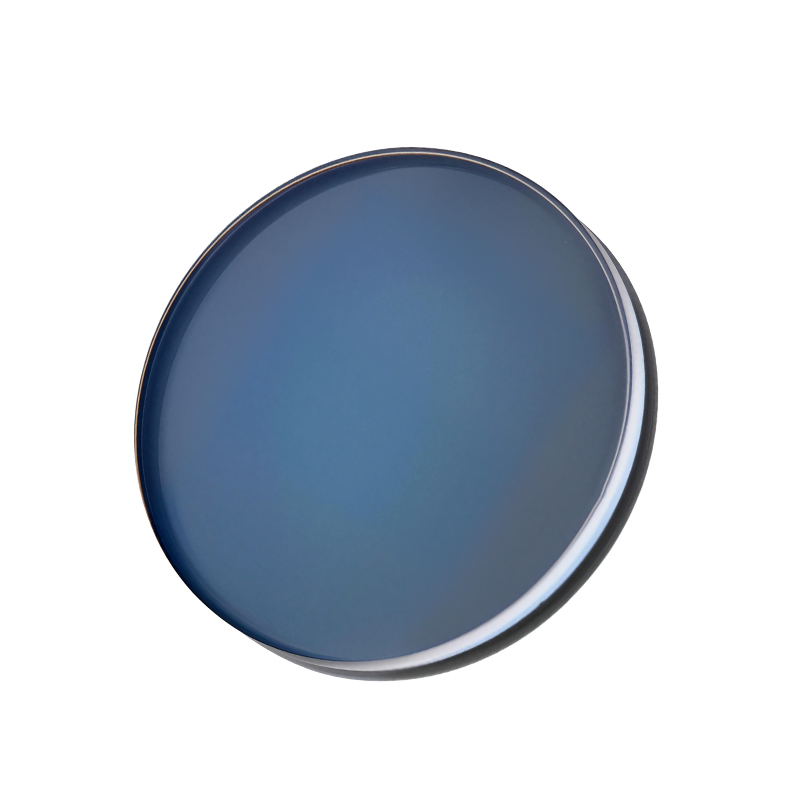
 1.61 MR-8 Green-Coated Single-Vision LensThis finished lens combines a high-index MR-8 material with a green multilayer coating, offering thinner edges, UV400 protection, and reduced glare for moderate to high prescriptions.View Product →
Common types of glasses lens material at a glance
| Material |
Refractive Index |
Abbe Value |
Impact Resistance |
Best For |
| Glass |
1.50–1.90 |
30–58 |
Poor |
Specialized optics |
| Standard plastic |
1.50 |
~58 |
Moderate |
Everyday low-moderate Rx |
| Polycarbonate |
1.59 |
~30 |
Excellent |
Kids, sports, safety |
| Trivex |
1.53 |
~45 |
Excellent |
Impact-resistant high clarity |
| High-index 1.60 |
1.60 |
~42 |
Good |
Moderate-high prescriptions |
| High-index 1.67 |
1.67 |
~32 |
Good |
High prescriptions |
| High-index 1.74 |
1.74 |
~33 |
Good |
Very high prescriptions |
Lens Index and Optical Performance
Once you understand the material family, the next step is matching the refractive index to your prescription. A higher index is not automatically better; it depends on your power, your frame, and how much you value thinness versus optical purity.
What "refractive index" means
Refractive index describes how efficiently a lens material bends light. A higher index means the lens curves less to achieve the same power, which reduces edge thickness in minus lenses and centre thickness in plus lenses. For someone with a prescription above -4.00 or +3.00, a 1.60 or 1.67 index lens can make the finished glasses noticeably slimmer and lighter. For low prescriptions, a standard 1.50 plastic lens may be the better balance of cost and clarity.
Abbe value and visual clarity
Abbe value measures chromatic dispersion, which is the tendency of coloured light to separate as it passes through the lens. A higher Abbe value generally means less colour fringing, especially at the lens edges. This is why we often recommend standard plastic or Trivex when crispness matters most, and high-index lenses only when the prescription truly needs the thinness.
Aspheric design
Many lens designs now use aspheric curves, especially in high-index materials. An aspheric surface flattens the peripheral curve, which reduces distortion and makes the lens look slimmer. It is particularly helpful for strong prescriptions in flat or wrap-style frames. Because aspheric processing requires precise manufacturing, this is where a lens maker's engineering experience becomes important.
Materials and Coatings Work Together
Lens material is only half of the visual experience. Modern coatings are designed to improve durability and comfort, but they must be matched to the material underneath. For example, anti-reflection (AR) coatings reduce glare and reflections, which matters more on high-index lenses because they naturally reflect more light. Hard coatings protect softer resin surfaces from scratching, and hydrophobic or oleophobic topcoats help keep lenses clean.
Another consideration is built-in protection. Photochromic lenses, which darken in sunlight, can be made from standard plastic, polycarbonate, or high-index materials. Blue-light filtering coatings are often applied to lenses used for digital work, and polarized lenses are popular in sunglasses. When selecting from the types of glasses lens material, think about your daily environment as much as your prescription.
We manufacture many functional combinations, including blue-blocking lenses in 1.56, 1.61, and 1.67, and photochromic lenses with gray or green tint. These options show how material selection and coating technology combine to solve real-life problems, not just numbers on a prescription.
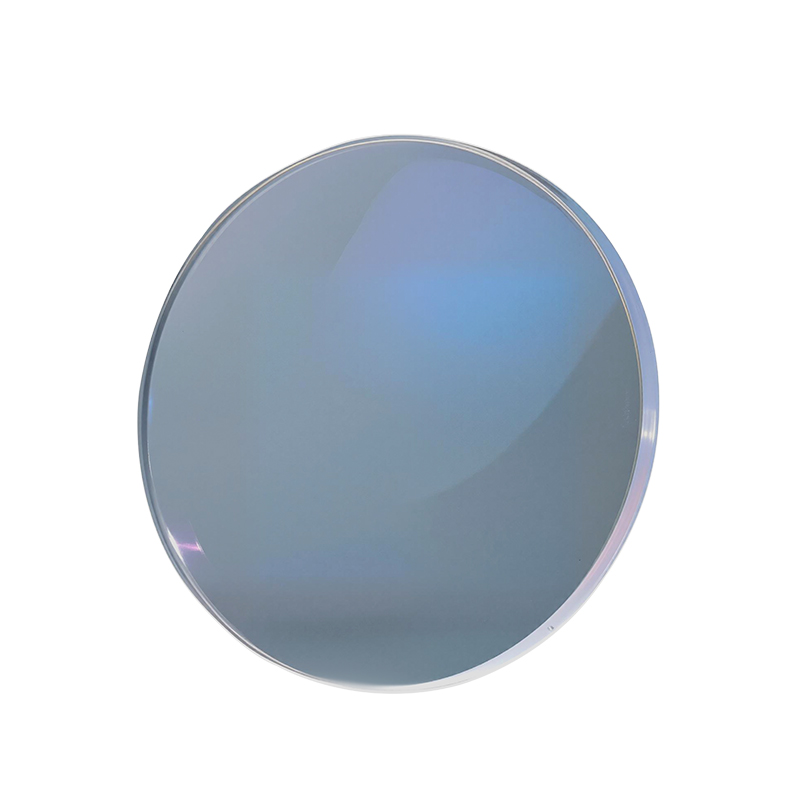
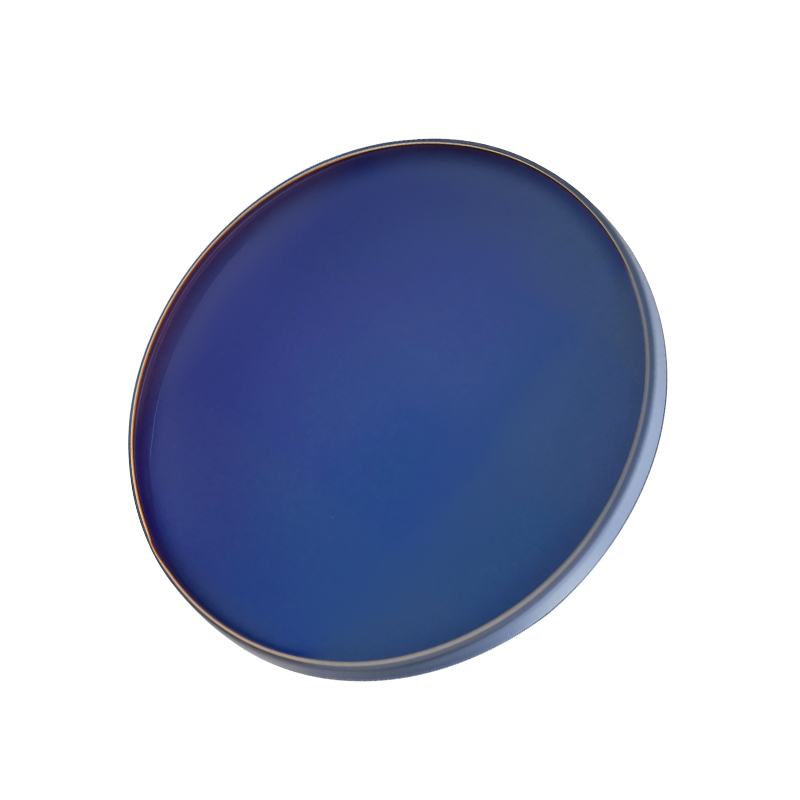
 1.67 Blue-Blocking TI-Purple Coated LensA high-index 1.67 lens with TI-purple coating that filters harmful blue light while keeping beneficial light, reducing edge thickness and weight for strong prescriptions.View Product →
A Manufacturer's Perspective on Lens Material
As a company that produces high-end resin lenses, we see lens materials differently than many retailers do. Behind every material choice is a production process that affects consistency, coating adhesion, and final performance. In our vertically integrated factory, we control everything from material handling and curing to surfacing and coating. That means the lens we design and the material we select are tested together, not merely assembled from components.
We also manufacture semifinished lenses, which are used by optical laboratories and finishing houses. These blanks are available in 1.49, 1.56, 1.61, and 1.67, with or without hardening or multi-layer coatings. Providing semifinished lenses lets our partners choose the material type that fits their local market, then apply their own prescription surfacing. This is an important part of the material ecosystem that often gets overlooked by consumers.
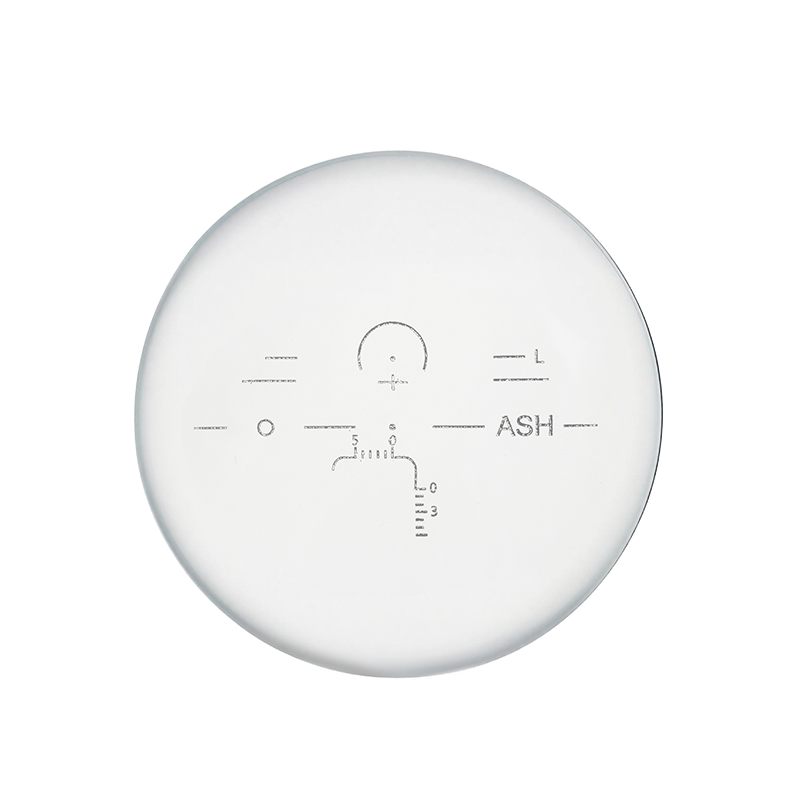
 1.67 Semi-Finished Single-Vision Lens BlankThis semi-finished 1.67 blank allows optical labs to apply custom prescriptions, offering a thinner option with available coatings for durable, anti-reflective results.View Product →
If you are comparing suppliers or need a refresher on material terminology, our lens material guide offers a practical overview.
Final Thoughts
There is no single "best" lens material, only the right one for your prescription, lifestyle, and budget. Start by understanding the main types of glasses lens material — standard plastic, polycarbonate, Trivex, and high-index — then think about how coatings and design will affect the final result. If you are a brand, optical chain, or lab, the same principle applies: choose a lens supplier who understands materials deeply and can offer the right combination. Explore our range of optical lenses to see how decades of manufacturing experience translate into dependable products.

 English
 Français
 Español
 عربى
 中文